I'll come right out and say it. This was the second time I've started CSR309. From the beginning it has been the same feeling, that there isn't enough time. Even though it is a leadership class, I learned something a little more useful to me. The power of time management.
Throughout the semester I have been plagued by poor time decisions. Missing classes to make up work I should have done before, writing papers while at my job, and generally scrabbling for every second I could grab. Not because I had a schedule that demanded it, no, but because I make a poor use of my time. Staying up late, partying when I shouldn't, video games; all massive wastes of time that I could have used for something more productive. Something that would have lessened my stress in the long run instead of merely that day.
Before this class my thoughts had always been: I need more time, there isn't enough time, how does anyone do this on time? It was really only in during the span of this class that I was able to metaphorically and literally get my feet under me. Proper time management, being where I needed to be, and actually knowing what I was doing there. In order to become a better leader to others, I had to be a better leader of myself, and that meant better budgeting of my time. While this may not have been the intended lesson to be learned in this class it is a very powerful lesson to learn. I'm only upset that it took me so long to finally understand it.
Like I said this was the second time that I had started CSR309, I knew what was coming, I knew there would be a time to stand up and take control, but I didn't take that opportunity, I wasted it. On the thought that there wouldn't be enough time for me to be an effective leader, I wasted it because I thought that I wouldn't be able to be available enough, I wasted it because I thought that I couldn't do a good enough job.
I know now that there is always time to be exceptional, as Mr. Feinberg says, "This course can change your life." Being able to take charge of myself, to truly be in charge of my own life, to me, is a much needed and hard fought lesson learned. This course did change my life, and I'm glad I stuck it out.
Monday, April 20, 2015

Wishy-Washy Leadership Types
As a leader you have to make decisions. Whether it's about a school project, or the decision to make a critical business move, you have got to be quick and ready with your decisions and follow through on them.

One way or another, you will have to make a decision, your team looks to you for that very reason. You are in control of how the team focuses it's energy, and how they will in turn achieve their goal. That is why you were elevated above the others in the group; through your decisions and actions you place your team on a path toward success or failure, and to stumble in your decisions means that you can't even start.
I'm the boss!

You will do as I say, when I say it. A mindset that inspired "Heavyweights" (1995) the best movie featuring a weight loss camp in America.
During the movie the campers angered by poor conditions and 'heavy' sanctions set by Camp Hope owner Tony Perkis, revolt against him, all the while accomplishing their goal to win the Apache Relay race. It's a heart warming story of a group of misfits overcoming adversity through team work. But they still failed their leader set goal, the true reason they were at Camp Hope. They did not lose the weight (at least not right away) they failed. Because of bad leadership.
Perkis saw their failure as a lack of effort and a front against himself as leader. He was trying to help them lose weight with the Perkis Method and they were going to do it together! Perkis's goal for the group was so different that it drove the campers to revolt, and drove perkis insane(r).
Friday, April 10, 2015
The Fold
When a leader is to willing to compromise, they can compromise their entire team's effectiveness. A leader who isn't in charge is no more a leader than any stranger off the streets.
It may seem like the opposite of empathy, when in reality it is not. A leader may be empathetic while still refusing to fold on what they have decided must happen. Making an employee work late, or making a scholastic team member repeat an assignment may seem heartless, when in reality it is necessary for the success of the business or team as a whole.
It may seem like the opposite of empathy, when in reality it is not. A leader may be empathetic while still refusing to fold on what they have decided must happen. Making an employee work late, or making a scholastic team member repeat an assignment may seem heartless, when in reality it is necessary for the success of the business or team as a whole.
Change
A good leader must be able to accept and even encourage change. Change is always happening, when a business or team does not change they tend to get left behind.
For example...
For example...
Empathy
Putting yourself in someone else's shoes.
A good leader has to be able to understand what their team is going through. What trials and tribulations they may be experiencing, and then act accordingly.
That is to say a leader can understand, not that they will fold.
When an issue arises they as a leader will have to make the tough call, whether they try to work around the situation or not is a matter of judgement.
An example of this is whether a manager will allow an employee to miss work based on an issue. It will always come down to whether or not the rest of the employees can manage without them. Can that person be missed, can the machine that is the team work without them. Often others on the team can cover for the missing person and they can miss work.
Sometimes they can't, and that is the hard decision that leaders must make.
Unofficial leadership: Age
The older you are, the longer you've worked somewhere, the more people look to you as a leader. It may not be your actual position, you may be a dishwasher, but the longer you've done a job the more you're expected to be the leader.
Think of a CEO, probably an older person, right? They probably look like they have all the answers, they've been there, they've got experience, they know the game they play.
It's a natural reaction, but do they deserve any respect more than a youngster? Does their age or longevity at a company mean that they are better suited to lead that company. Maybe not.
(personal account)
When I was a new freshman at Purdue, I had a summer job frying donuts. I was told that I had to fry every donut in the curing cupboard (where the dough rises) and then clean up the shop before I left. We had been busy all day and I was behind by an hour, but I was finishing up quickly. A older co-worker approached me and told me that the boss, Tom Saylor would be upset if I was still there when he arrived. I hastened my cleaning, but still did a thorough job. However he arrived before I could finish. He was not upset in the least.
I had taken the word of a long-time employee and had rushed my job to not displease the owner, for nothing. I was still late getting done, and no repercussions came my way. I had taken the co-worker's word because she had been there longer than me, and so obviously knew what was expected.
But what I was told was expected of me, and what was actually expected of me were two different things. Just because she had been seniority over me did not mean she was in charge of my work. I was in charge of my work, and as long as it was done right the first time, and I kept up with my co-worker (who rolled out the donuts in the first place) I was free to take my time. Wasted product was more important than speed.
I had put faith in the senior members of the team and it turned out to be misplaced. Tom made it very clear what I was to do, my co-workers muddled it.

Think of a CEO, probably an older person, right? They probably look like they have all the answers, they've been there, they've got experience, they know the game they play.
It's a natural reaction, but do they deserve any respect more than a youngster? Does their age or longevity at a company mean that they are better suited to lead that company. Maybe not.
(personal account)
When I was a new freshman at Purdue, I had a summer job frying donuts. I was told that I had to fry every donut in the curing cupboard (where the dough rises) and then clean up the shop before I left. We had been busy all day and I was behind by an hour, but I was finishing up quickly. A older co-worker approached me and told me that the boss, Tom Saylor would be upset if I was still there when he arrived. I hastened my cleaning, but still did a thorough job. However he arrived before I could finish. He was not upset in the least.
I had taken the word of a long-time employee and had rushed my job to not displease the owner, for nothing. I was still late getting done, and no repercussions came my way. I had taken the co-worker's word because she had been there longer than me, and so obviously knew what was expected.
But what I was told was expected of me, and what was actually expected of me were two different things. Just because she had been seniority over me did not mean she was in charge of my work. I was in charge of my work, and as long as it was done right the first time, and I kept up with my co-worker (who rolled out the donuts in the first place) I was free to take my time. Wasted product was more important than speed.
I had put faith in the senior members of the team and it turned out to be misplaced. Tom made it very clear what I was to do, my co-workers muddled it.

One of the worst jobs ever
Downward Communication, the Voice of Managment
Like most of life's problems the lack of or just poor nature of communication can cause problems. Resentment can stem off of even the most offhanded of comments, "The kitchen was slow tonight," ,"The customer's aren't happy," ,"The paychecks aren't here yet." Literally any comment can and probably will rub someone the wrong way. As a manager you must be able to add to that, you must be able to communicate the why.
Why aren't the customers happy? - What can we do? - Where are we going wrong?
Not every employee can see the customers and so the why is very important to improving the quality of the work being done. Managers/Leaders need to be able to communicate that information downward so that their team can make the proper adjustments. Just telling them that there is a problem is not enough.
There has to be substance to communicating problems in order for any quality changes to be made.

Why aren't the customers happy? - What can we do? - Where are we going wrong?
Not every employee can see the customers and so the why is very important to improving the quality of the work being done. Managers/Leaders need to be able to communicate that information downward so that their team can make the proper adjustments. Just telling them that there is a problem is not enough.
There has to be substance to communicating problems in order for any quality changes to be made.
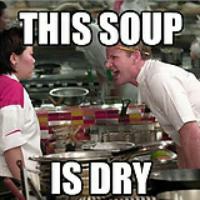
Well, why do you think that is Ramsey?
Personal Failures
I have been thrown into a few leadership positions in my life, from being the Senior Patrol leader of my Boy Scout troop, to being the head cook at my job. One unanimous thing that I have failed as a leader in is micromanaging. I have trouble trusting my team to do the job.
The perfect example comes from my coworkers. "You don't tell us what we need to do, you just try to do it all yourself." Thinking back on that and other situations, it is very true. When I get going on a job, I get going on the whole job. I have literally been chased back to my station in the kitchen because of it.
The lesson to be learned is trust. Trust in your team to get the job done. They want to succeed as much you do, and trying to do their job and micromanaging does not help the team's effort, rather it hinders the team. You're not doing your job because you're trying to do theirs.
The perfect example comes from my coworkers. "You don't tell us what we need to do, you just try to do it all yourself." Thinking back on that and other situations, it is very true. When I get going on a job, I get going on the whole job. I have literally been chased back to my station in the kitchen because of it.
The lesson to be learned is trust. Trust in your team to get the job done. They want to succeed as much you do, and trying to do their job and micromanaging does not help the team's effort, rather it hinders the team. You're not doing your job because you're trying to do theirs.
Practice What you Preach
As the leader, be it of a major company or of a small team, you must avoid all hypocrisy. What you say, you must do; so to speak. But it goes much further than that. You must live the life that you preset to your followers. The fastest way to lose the respect of your team is to be obviously hypocritical.
A real life example of this is my current job as a cook. The owner had pushed back payday another day, from Friday to Saturday, and still expected her workers to work just as hard. Now one day is not a big deal, it's only one day, but it shows the level of respect we garner for our work. She is the one that gets the checks and the only way we employees get paid is by her bringing the checks in and giving them to us. When we get paid is completely up to her, the checks are given to her by the payment company on Thursday of every other week, and we have to wait until Saturday to receive payment. We have to wait, because she doesn't want to sign the checks or we're just not that important.
Over time a general attitude of "I hate this place" has formed throughout the store, and it isn't the managers, but rather the owner that started it. She wants us to work hard, but isn't willing to pay us promptly for it. In the past payday was on every second Friday, now we have to wait, and work ethic has suffered.

A real life example of this is my current job as a cook. The owner had pushed back payday another day, from Friday to Saturday, and still expected her workers to work just as hard. Now one day is not a big deal, it's only one day, but it shows the level of respect we garner for our work. She is the one that gets the checks and the only way we employees get paid is by her bringing the checks in and giving them to us. When we get paid is completely up to her, the checks are given to her by the payment company on Thursday of every other week, and we have to wait until Saturday to receive payment. We have to wait, because she doesn't want to sign the checks or we're just not that important.
Over time a general attitude of "I hate this place" has formed throughout the store, and it isn't the managers, but rather the owner that started it. She wants us to work hard, but isn't willing to pay us promptly for it. In the past payday was on every second Friday, now we have to wait, and work ethic has suffered.

Such is the Power Structure
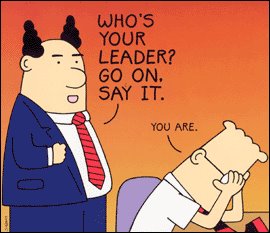
A major problem that many leaders face is the propensity for the leader to become more imporant to themselves than they are to the company they serve. Essentially the leader becomes more than their role would deem and therein lies the problem. When the power structure is made evident it can create resentment for that leader. During the episode of The Profit, Courage b, Niklas immediately points out that he is the manager of the company, cutting off his sister and cofounder during the conversation and asserting himself and pointing out the structure of the company.
In the comic Dilbert, The Boss makes it very clear who is in charge. Even in the single picture above he is pointing out the power structure. If you are familiar with Dilbert, you know that Dilbert and the other engineers are never taken seriously and that The Boss is incompitant when it comes to the business that he manages. Yet he still, almost maliciously, points out that he is the leader.
A good leader does not need to assert themselves as leader, they should be elevated to that position by the employee's that they manage.
Thursday, April 9, 2015
Cornerstone
Over the last few months the Youtube group The Yogscast have been playing a group game of Minecraft. Simple enough, right? Meant to be a group effort in playing an open world sandbox game the group has splintered into three factions and underhanded dealings between the factions have caused havok where there should have been smooth progress.
From the begining constant leadership changes, power struggles, and general bad behavior have kept them from really getting anything done. Each week the group would elect a new "Mayor" based on what the candidate had planned for them that week. They lacked focus. Often the groups would either change their entire plan, or just ignore what the leader had to say. There was no respect for the leader because the role would be filled by whomever was bored and wanted to do something else. The role was literally devolved to a running joke, and while the drama and jokes are a good thing for views, they are bad for the teams progress.
Late Night with Cry and Russ
(skip to 4:30 for a lesson in bad leadership)
Every Saturday at 11pm est YouTube.com "stars" Cryaotic (Cry), RussMoney(Russ). Cheyenne, SolidSnake, and ScottJund(Jund) host a video game stream on Twitch.com. Typically Cry makes the schedule for games that the group will be playing that particular night, however this week he gave control to Russ and Jund.
Immediately he criticized the schedule. Claiming that, yes, they were going to use it, but that he could still complain about it. As the unofficial leader of the Late Night stream he delegated the task of making the schedule down to Russ and Jund and then complained about it. He is the last person who should complain, even if it were just for the sake of comedy. The leader, openly mocking his team, over a decision that they made.
That is not good leadership, Even for something as mundane as video games.
Wednesday, April 1, 2015
Six Characteristics of 21st Century Leadership
Link to the Forbes.com article. (opens new window)
The Forbes.com article "Six Characteristics of 21st Century Leadership" details six traits that, Western Union President for the Americas and European Union Region, Odilon Almeida embodies and believes define what it means to be a leader in the 21st century.
1. Keep your Immigrant Perspective (See Opportunity in Everything)
2. Employ your Circular Vision (Anticipate the Unexpected)
3. Unleash your Passionate Pursuits (Strive for Excellence)
4. Live with an Entrepreneurial Spirit (Innovation Comes Second Nature)
5. Work with a Generous Purpose (Share Momentum with Others)
6. Embrace your Cultural Promise (Lead to Leave a Legacy)
The twenty first century is at the pinnacle of change. Literally everything around us is constantly being innovated and changed. We have jobs now that weren't anticipated even five years ago. Whole professions invented due to the speed of innovation. Someone started each and every one of them. They saw something that others did not, and they ran with it; they knew what they were doing before anyone else even knew they could do it.
Microsoft as a company was started April 4, 1975. Today it is ranked 34th in all of Fortune 500 companies. Bill Gates himself is richer than 140 separate countries. A business, started in a garage by a college droppout, became a software powerhouse, and that dropout became the world richest man. He saw his opportunity and he took it. Leading his company through the adversity of a digital revolution and keeping it both relevant and powerful. His is a legacy that people the world over recognize today, changing lives the world over, giving opportunity to millions, and opening up the software industry. As a leader he embodies all six of these traights in one form or another, and it shows in the success of Microsoft.
Other links
http://articles.economictimes.indiatimes.com/2009-10-02/news/28468983_1_richest-man-richest-persons-forbes
http://www.accountingdegree.com/blog/2011/10-big-businesses-that-started-in-a-garage/
http://www.forbes.com/sites/kerryadolan/2015/03/02/inside-the-2015-forbes-billionaires-list-facts-and-figures/
The Forbes.com article "Six Characteristics of 21st Century Leadership" details six traits that, Western Union President for the Americas and European Union Region, Odilon Almeida embodies and believes define what it means to be a leader in the 21st century.
1. Keep your Immigrant Perspective (See Opportunity in Everything)
2. Employ your Circular Vision (Anticipate the Unexpected)
3. Unleash your Passionate Pursuits (Strive for Excellence)
4. Live with an Entrepreneurial Spirit (Innovation Comes Second Nature)
5. Work with a Generous Purpose (Share Momentum with Others)
6. Embrace your Cultural Promise (Lead to Leave a Legacy)
The twenty first century is at the pinnacle of change. Literally everything around us is constantly being innovated and changed. We have jobs now that weren't anticipated even five years ago. Whole professions invented due to the speed of innovation. Someone started each and every one of them. They saw something that others did not, and they ran with it; they knew what they were doing before anyone else even knew they could do it.
Microsoft as a company was started April 4, 1975. Today it is ranked 34th in all of Fortune 500 companies. Bill Gates himself is richer than 140 separate countries. A business, started in a garage by a college droppout, became a software powerhouse, and that dropout became the world richest man. He saw his opportunity and he took it. Leading his company through the adversity of a digital revolution and keeping it both relevant and powerful. His is a legacy that people the world over recognize today, changing lives the world over, giving opportunity to millions, and opening up the software industry. As a leader he embodies all six of these traights in one form or another, and it shows in the success of Microsoft.
Other links
http://articles.economictimes.indiatimes.com/2009-10-02/news/28468983_1_richest-man-richest-persons-forbes
http://www.accountingdegree.com/blog/2011/10-big-businesses-that-started-in-a-garage/
http://www.forbes.com/sites/kerryadolan/2015/03/02/inside-the-2015-forbes-billionaires-list-facts-and-figures/
Subscribe to:
Comments (Atom)